Conversions Matter Framework

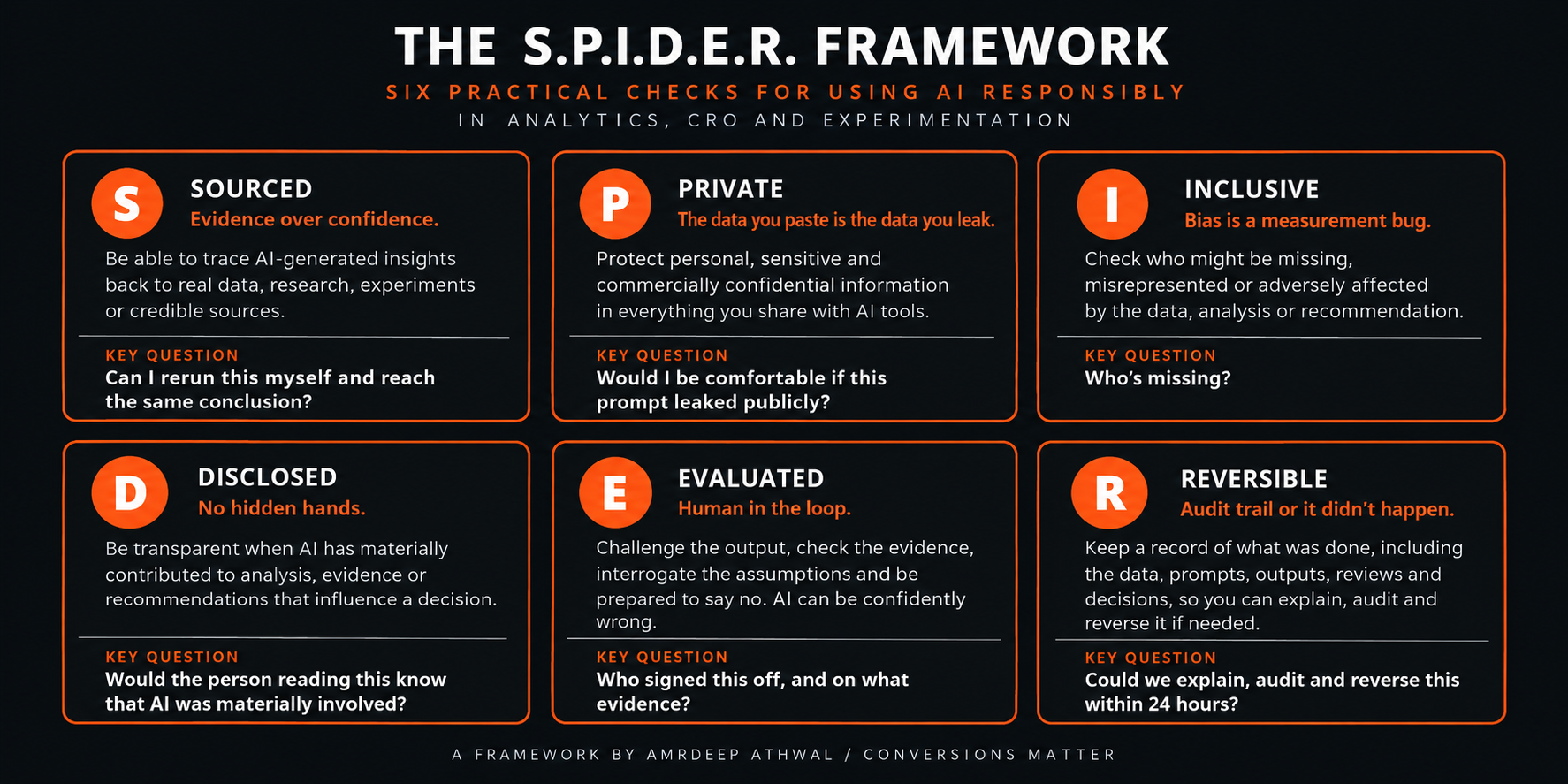
The S.P.I.D.E.R. Framework for Responsible AI

Six practical checks for using AI responsibly in analytics, CRO and experimentation.

AI is changing how we work.

Research that took hours can take minutes. Complex datasets can be queried using natural language. Anomalies can be identified at scale. Hypotheses can be generated in seconds.

That's genuinely exciting.

But faster doesn't automatically mean better.

And it definitely doesn't mean right.

The S.P.I.D.E.R. Framework is a practical way to check AI-assisted work before it influences an analysis, experiment or business decision.

Explore the framework ↓
If you can't tick all six, you're not ready to ship.

Six checks. One responsibility.

Sourced. Private. Inclusive. Disclosed. Evaluated. Reversible.

The S.P.I.D.E.R. Framework for Responsible AI by Amrdeep Athwal and Conversions Matter Download the S.P.I.D.E.R. Framework ↓

Using S.P.I.D.E.R.? Feel free. That's why I made it. Just credit Amrdeep Athwal / Conversions Matter when sharing or reproducing the framework.

Why S.P.I.D.E.R.?

AI has made getting an answer cheap.

Not that long ago, a fairly typical analytics workflow looked something like this:

Then
SQL → Export → Excel → Chart → Deck → Review → Ship
2 days
Now
Prompt → AI insight → Review → Ship
20 minutes

That's an extraordinary productivity gain.

It also removes a lot of the points where questionable analysis used to get challenged.

AI can give you an incorrect answer with absolute confidence.

It can generate hypotheses with no research behind them.

It can keep slicing your experiment results until something looks significant.

It can analyse biased data and give you a beautifully written biased conclusion.

And it can make sharing data you really shouldn't be sharing incredibly easy.

Confidence is not correctness.

AI hasn't removed our responsibility to question the evidence.

If anything, it has made that responsibility more important.

That's why I created S.P.I.D.E.R.

The framework

The six S.P.I.D.E.R. checks

S

Sourced

Evidence over confidence.

AI is very good at producing answers that sound right. That isn't enough.

If AI identifies an interesting segment, spots a conversion problem or produces an insight, you need to be able to trace that conclusion back to something real.

A dataset. A query. Research. An experiment. A source.

And ideally, you should be able to reproduce it.

The S.P.I.D.E.R. check Can I rerun this myself and reach the same conclusion?

If the answer is "Well, ChatGPT said..." you haven't got an insight yet. You've got a claim.

P

Private

The data you paste is the data you leak.

AI tools become considerably more useful when you give them context. Unfortunately, that's also where things can go wrong very quickly.

Analytics exports can contain identifiers. Customer research can contain personal information. Experiment documentation can contain commercially sensitive information.

Client data doesn't stop being confidential because copying it into a prompt is convenient.

The S.P.I.D.E.R. check Would I be comfortable if this prompt leaked publicly?
I

Inclusive

Bias is a measurement bug.

AI doesn't magically fix biased data. It can just help you process it faster.

If a group is missing from your data, running that dataset through an LLM doesn't suddenly put them back in.

And because the resulting analysis can look sophisticated, we risk becoming more confident in the conclusion rather than less.

The S.P.I.D.E.R. check Who's missing?

AI might be doing the analysis. We're still responsible for who gets left out.

D

Disclosed

No hidden hands.

I don't think every email needs a warning because AI helped fix your grammar. That isn't the point.

But there is a difference between using AI to tidy some copy and using AI to generate analysis, evidence or recommendations that influence a decision.

When AI materially contributes to the latter, people should be able to understand that.

The S.P.I.D.E.R. check Would the person reading this know that AI was materially involved?
E

Evaluated

Human in the loop.

This one sounds obvious. It isn't.

Copying an AI-generated insight into a PowerPoint deck and reading it before presenting doesn't count as human evaluation.

Someone needs to interrogate the evidence, challenge the assumptions, check the methodology and be prepared to say:

No. That's wrong.

AI will happily generate ungrounded hypotheses, slice results until something becomes "significant" and contaminate the very control group you're trying to measure.

AI will happily p-hack on your behalf.

The S.P.I.D.E.R. check Who signed this off, and on what evidence?
R

Reversible

Audit trail or it didn't happen.

AI makes it possible to move very quickly. That makes knowing what actually happened even more important.

If an AI-assisted decision goes wrong, can you reconstruct it?

What data went in? What was the prompt? What did the model produce? Who reviewed it? What decision was made? What changed as a result?

And then the uncomfortable question:

Can we undo it?

The S.P.I.D.E.R. check Could we explain, audit and reverse this within 24 hours?

✓ ✓ ✓ ✓ ✓ ✓

Six ticks? Ship it.

Five ticks?

You're not ready to ship.

Put it into practice

Run the S.P.I.D.E.R. check

Before AI-assisted work influences an analysis, experiment or decision, ask:

Sourced
Can I independently reproduce or verify the evidence?
Private
Is everything I've shared appropriate for this AI environment?
Inclusive
Who might be absent, misrepresented or adversely affected?
Disclosed
Is material AI involvement appropriately transparent?
Evaluated
Has someone actually challenged the output and the evidence?
Reversible
Can we audit what happened and undo the resulting action?

Five out of six doesn't make you 83% responsible.

S.P.I.D.E.R. isn't a score.

Each principle protects against a different failure. If one fails, fix it.

Then ship.

The story behind the framework

Why I created S.P.I.D.E.R.

I work across analytics, CRO and experimentation.

I'm not an AI doomer. I'm definitely not an AI hype-bro either.

I use AI. The productivity gains are real.

But I've also watched the time between question → answer → action collapse.

The easier it becomes to produce analysis, insights and hypotheses, the easier it becomes to produce bad ones too.

So I wanted something practical.

Not another 70-page AI governance document that gets approved by a committee, uploaded to SharePoint and never seen again.

Six checks you can actually remember while doing the work.

Sourced. Private. Inclusive. Disclosed. Evaluated. Reversible.

The S.P.I.D.E.R. Framework for Responsible AI was created by Amrdeep Athwal of Conversions Matter as part of my talk:

AI: With Great Power Comes Great Responsibility.

Take it with you

Take S.P.I.D.E.R. back to your team.

You don't need an AI ethics committee meeting every time someone opens an LLM.

But you do need some basic checks.

Use S.P.I.D.E.R. before your next AI-assisted analysis, experiment or decision.

Download the S.P.I.D.E.R. Framework ↓

Free to use internally. If you reproduce or reference the framework publicly, please credit Amrdeep Athwal / Conversions Matter.

AI changes the tools.

It doesn't change the responsibility.

Good analysts still need to verify their evidence.

Good experimenters still need to protect the integrity of their experiments.

Organisations still need to protect customer data.

Somebody still needs to take responsibility for the decision.

AI didn't create those responsibilities.

It just made it possible to ignore them much faster.

With great power comes great responsibility.

It always did.

It always will.

Talk to Conversions Matter →